
Textile Sales CRM
All orders at one Place
Sales to Billing Simplified
Multi branch Inventory
One Solution. All Segments
Sales to Billing Simplified
One platform. Multiple integrations.
Insights, tips, and industry updates
Who we are
Get in touch anytime
Grow together with Wortal
 Inquiry Management
 Smart Follow Up
 Deal Tracking
 Customer History
 Field Visit Tracking
 Quotation Automation
 Custom Pipelines
 Workflows & Customization
 Capture Order
 Track Order Journey
 Dashboard & Reports
 Customer Order App - BizKart
 GST Invoicing
 e-way bill
 e-Invoice
Dashboard & Reports
e-Invoice
Dashboard & Reports
 Product Catalogue
 Stock Management
 Multi Branch Inventory
 Multi warehouse Inventory
Dashboard & Reports
Multi warehouse Inventory
Dashboard & Reports
 Textile Fabric Traders
 Garment Manufacturer
 Readymade Garment Wholesalers
 Digital Printing Houses
 Textile Traders & Wholesalers
 Sales
Sales
 Marketing
 Operations
 Accounting
 Jayshree
 08 Apr, 2026
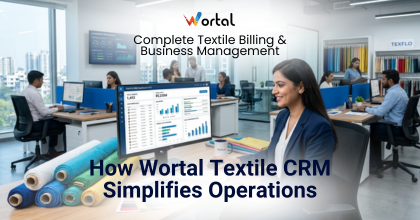
The textile industry operates in a highly competitive and fast-paced environment. From managing customer inquiries to handling large fabric inventories, processing orders, and generating invoices, textile businesses deal with complex workflows every day. Many textile traders, manufacturers, and wholesalers still rely on spreadsheets or manual registers to manage these operations. However, manual systems often create problems such as billing errors, inventory mismatches, delayed order processing, and poor customer tracking.
This is where a specialized solution like Wortal Textile CRM becomes extremely valuable. A powerful textile CRM platform integrates customer management, order processing, inventory tracking, and billing into a one centralized system. With the help of textile billing software and CRM automation, businesses can streamline operations, reduce manual work, and increase overall efficiency.
In this article, we will explore how modern textile CRM software helps businesses manage the entire workflow from inquiry management to final billing while improving productivity and profitability.
The textile industry has unique operational challenges compared to other industries. Businesses often deal with hundreds of fabric types, colors, designs, and sizes. Each customer may require different fabric specifications, custom quantities, or delivery schedules. Managing such complex information manually can quickly become overwhelming.
A textile CRM system is designed specifically to handle these challenges. It allows businesses to manage customer data, order details, inventory levels, and billing records in one centralized platform. Instead of switching between multiple systems or maintaining physical records, textile companies can manage everything digitally.
By implementing an advanced CRM solution, textile businesses can improve transparency, track every transaction, and ensure smooth coordination between sales, inventory, and accounting teams.
Every textile sale begins with an inquiry. Customers may request fabric samples, ask for pricing information, or inquire about available stock. If these inquiries are not properly recorded and followed up, businesses may lose potential sales opportunities.
A textile CRM platform helps businesses record all incoming inquiries along with customer details, product requirements, and communication history. Sales teams can easily track which inquiries are pending, which ones require follow-ups, and which have already been converted into orders.
This structured approach helps textile businesses maintain better relationships with customers and ensures that no sales opportunity is missed.
Once a customer inquiry is received, the next step is preparing a quotation. Textile businesses often need to include detailed information such as fabric specifications, pricing, quantities, and delivery timelines.
With modern textile order management software, quotations can be generated instantly. Instead of manually preparing documents, businesses can create professional quotations directly from the CRM system.
Once the customer approves the quotation, the system automatically converts it into a sales order. This eliminates duplicate data entry and reduces the risk of errors. Order processing becomes faster, and teams can focus more on fulfilling customer requirements.
Inventory management is one of the most challenging aspects of the textile industry. Businesses must track raw materials, unfinished fabrics, and finished products simultaneously. Without proper inventory management, companies may face stock shortages or excess inventory.
A dedicated fabric inventory management system within textile CRM software helps businesses monitor stock levels in real time. Each product can be categorized by fabric type, color, design, and measurement.
When a new order is placed, the system automatically updates inventory records. This ensures accurate stock tracking and prevents confusion between warehouse staff and sales teams.
Inventory automation also helps businesses plan production schedules more effectively and avoid unexpected delays.
Billing is a critical step in any business transaction. In the textile industry, invoices must include detailed product information, quantities, tax calculations, and payment terms.
Using advanced textile billing software, businesses can generate invoices quickly and accurately. The CRM system automatically calculates taxes, updates stock levels, and records payment information.
Automated billing provides several benefits including faster invoice generation, reduced calculation errors, accurate tax compliance, and better financial record keeping.
This not only improves operational efficiency but also enhances the overall customer experience.
Customer relationships play a crucial role in the success of textile businesses. Wholesale buyers, retailers, and distributors often work with suppliers for many years. Maintaining strong relationships with these customers can lead to repeat orders and long-term partnerships.
A textile CRM platform stores detailed customer profiles including purchase history, order preferences, and previous communications. This information allows businesses to provide personalized services and better product recommendations.
For example, if a retailer frequently orders a specific fabric design, the sales team can notify them whenever new stock becomes available. Such personalized engagement helps build trust and strengthens customer loyalty.
One of the biggest advantages of digital CRM systems is access to real-time business insights. Textile businesses can analyze sales performance, inventory movement, and customer activity through automated reports.
Businesses can identify which fabric products sell the most, which customers generate the highest revenue, seasonal demand trends, and profit margins for different product categories.
These insights help business owners make informed decisions and develop better growth strategies. Instead of relying on guesswork, companies can use data-driven insights to optimize pricing, improve marketing strategies, and expand product lines.
Automation is becoming essential for modern textile businesses. Manual tasks such as updating spreadsheets, calculating invoices, or checking stock levels consume a significant amount of time.
With textile CRM automation, many repetitive tasks are handled automatically. Orders update inventory automatically, invoices generate instantly after order completion, customer data is stored and organized digitally, and sales reports are generated in real time.
This automation allows employees to focus on strategic activities such as improving customer service and expanding the business.
As the textile industry continues to evolve, digital solutions are becoming essential for business growth. Companies that adopt advanced technologies gain a competitive advantage by improving efficiency and customer satisfaction.
A comprehensive platform like Wortal Textile CRM helps textile businesses modernize their operations. By integrating inquiry management, order processing, inventory tracking, and billing into one system, businesses can achieve better organization and faster decision-making.
Digital transformation is no longer optional for textile businesses. It has become a necessity for staying competitive in today’s market.
Managing a textile business involves numerous interconnected processes from handling customer inquiries to managing orders, tracking inventory, and generating invoices. When these processes are handled manually, businesses often face inefficiencies, errors, and communication gaps.
By implementing a powerful solution like Wortal Textile CRM, textile companies can streamline their entire workflow. Automated billing, smart inventory management, and centralized customer data allow businesses to operate more efficiently and provide better service to their clients.
As the textile industry becomes increasingly competitive, adopting modern tools like textile CRM and billing software will play a key role in driving growth, improving operational efficiency, and building long-term customer relationships.


